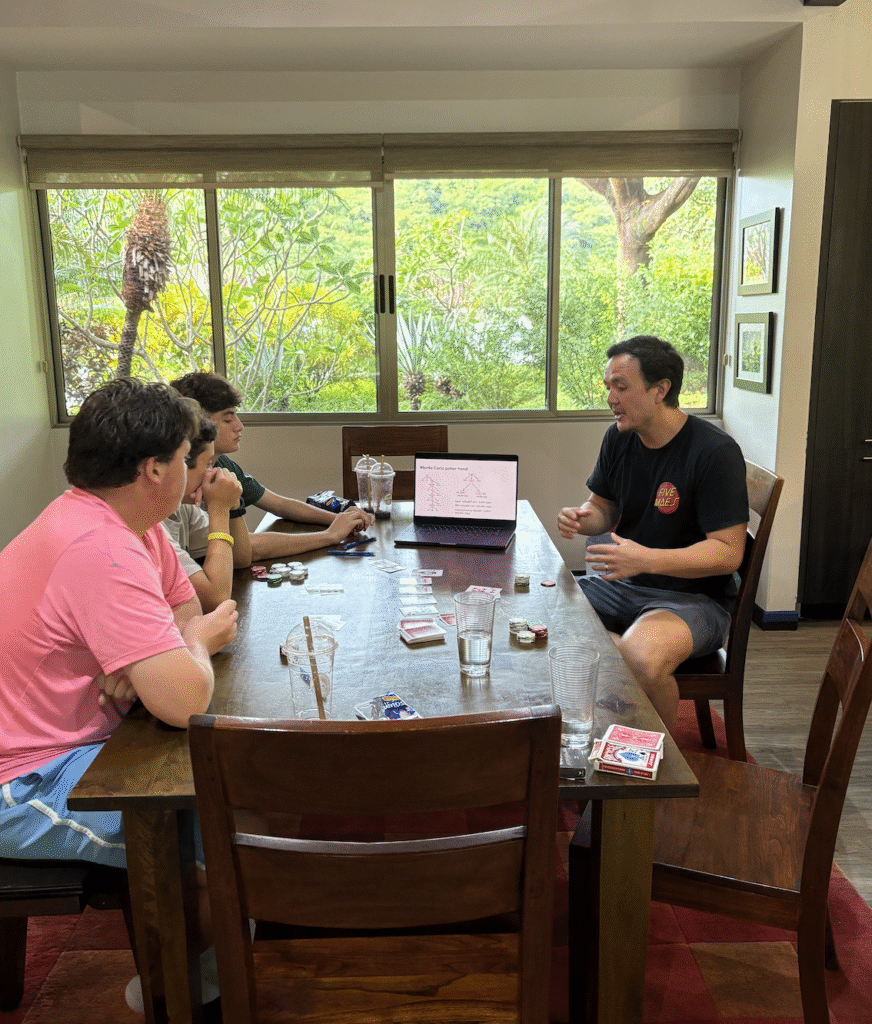
This week we had a special guest to teach us about decision trees. Brandon comes from a background of professional gambler and today CEO of a crypto market company. He created a decision tree that showed how decisions are made at every stage of Texas Hold 'Em.
It was fun to play cards with him and the boys while looking at the different decisions that could be made along the way - either on the flop, the turn or on the river. We all needed to make some decisions during the game and we needed to make those assuming different values. The boys were excited about the card playing and engaged with Brandon throughout.
Once Brandon left, we did a couple decision trees - one about deciding which market to enter and then a fictitious one about should we go to college and used Oliver as an example. They know how to draw a decision tree and they know the formula for the expected value for each chance node. I would like to revisit this topic in a few weeks.
However, next week, we are going to do a reflection of these decision making tools and see if they are helpful in daily life. Then we are going to go do some exploring in the community. We will start in Brasilito, then off to Flamingo and Potrero. I am looking forward to seeing what is out there to see.
Share this link with your friends.

 About The Wonderment Co-op

Nathaniel.Rappaport
October 15, 2025
Which of these 4 decision-making tactics do you think will be useful, or can these be useful, and why?
Opportunity cost
GANT chart
Values
Decision trees
I believe that opportunity cost and decision trees are the absolute most important and useful decision-making tactics. Opportunity cost is especially important in big decisions to make sure you figure both sides of a choice and make the choice in a rational, educated mind to ensure validity in the selected choice. Decision trees are a more unconscious way of thinking, as you’re finding a quick way to decide on a situation, you unconsciously figure out all options before making your choice. It’s especially helpful when trying to make a decision with the knowledge of all the other choices you have before the final decision.
Opportunity cost and decision trees are, in my opinion, interestingly similar as they can both affect your decision-making strategies as well as your way of deciding between choices as a whole. Both tactics force you to consider all your options, while making a decision tree you must think ahead and consider what choices you have now and what choices may come from your future choices, complicated, but I believe that with training your brain runs through these scenarios unconsciously. Whereas opportunity cost shows you your options where you need to then decide the better choice depending on what you gain and lose from choosing either one.
Did using these decision making tactics change the way thaty you think about/consider decisions?
When learning different ways to make decisions, you become able to think and analyze all your choices before deciding definitely. Before I learned these tactics I sort of unconsciously considered options when making a choice. Now that I have learned the brain process beind my decision making, I have been able to reflect on my decisions and if I make a mistake in my decision making process, I can then improve next time.
Oliver Helman
October 15, 2025
Which one of these 4 decision making tools will help us in the long run.
Opportunity cost
Will be used mostly for big decisions like deciding what project we are going to do for our project.
Decision tree
Gantt charts
Will probably be used more times than opportunity cost but for smaller things to figure out timelines while working on our project.
morals/values
Did using these tools change the way that you think differently about decisions?
Learning these tools makes me think about what could be lost not only what can be gained. In the case of thinking about jobs in the future – if there is a job available to work on an oil rig and make a lot of money, there is also the loss of a normal life.
Are any of them challenging to use or apply?
None of them are really challenging – the most challenging is gantt chart. Understanding the timeline – where they have to be located on the chart. Now that we have done it once and made mistakes – it is easier to understand that you really need to focus on the timeline and where to put it in the graph.
How does knowing the values influence your decisions?
The values decision making tactic is not as conscious as the other tools. And therefore there is always a bias toward your values that have formed over time, through experiences.