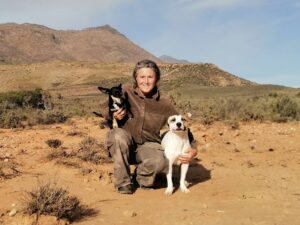
For many years I have worked quietly in landscapes across South Africa, observing wild bees in the places they have always lived — mountain gorges, remote valleys, farms, deserts, forests, savanna, urban areas, and intact wild systems.
Over time, something became increasingly clear to me.
Wild bees do not fit comfortably within existing conservation frameworks. They are small, numerous, and deeply embedded in the fabric of living systems — too interconnected to be protected through conventional methods such as fencing, species management, or economic valuation.
Again and again, I found myself working not only with the bees, but within relationships — with farmers, landowners, communities, and institutions. In these spaces, I witnessed a recurring ethical tension: the dominant conservation model is built on control, intervention, and justification, while the lives of wild bees depend on autonomy, continuity, and freedom from disturbance.
The deeper my work went, the more I understood that wild bees do not need to be managed, studied invasively, or made economically valuable in order to deserve protection. What they require is something much simpler and much more profound: for humans to recognise their right to exist undisturbed.
From this realisation, the concept of guardianship naturally emerged.
The Ujubee Wild Bee Guardianship Charter is not a conservation tool in the traditional sense. It is a statement of ethical relationship — a framework that invites humans to stand in right relation with wild bees by protecting the conditions that allow them to live freely, rather than attempting to control or use them.
It represents a paradigm shift: from an industrialised model of conservation based on intervention, toward a cooperative relationship with the living world.
This charter therefore arises directly from lived experience — years of listening to landscapes, witnessing the lives of wild bees, and learning that true protection begins not with intervention or ownership, but with humility.
In this way, my work has never been about managing bees, but about learning how humans can stand beside them — as quiet guardians rather than controllers.
The great concern to me is that Bees are not understood as wild animals. In order to interact with a wild animal, one would think that one would need to understand the animal in its wild state in order to work with that wild state and not against it, so that the animal is constantly supported and healthy. That, however, is not the case with Bees. Bees have never been studied in the wild. Wild honeybees are native only to Africa, Asia and Europe. And yet humans have taken them to all continents of the world to pollinate crops and make honey for human consumption with no underlying understanding of their true nature, their needs or the complexity of their natural ecosystems. The existing narrative about bees has emerged from their study and exploitation for industry not from the wisdom of the wild bee as an essential component of Nature and all biodiversity.
Bees need to be understood as the wild animals they are. The existing narrative needs to change and reflect them as they truly are, not as they are when managed by humans. Beekeepers and the agricultural industry have agendas that prohibit them from being able to understand the bee as a wild animal. Wild Bees need protection, understanding and space to be who they are. And as with everything in Nature, protecting space for wild bees will protects all the other beings both large and small who coexist in their ecosystem.
An exploration of relationship between Nature, humans, and AI, where Nature remains the central foundation and all understanding arises from lived ecological observation.
Thoughts on how it all started and how this weaves through my life now.
What we think we know about honeybees has come from Industry; Agriculture, Beekeeping, Honey Production. Honey Bees have never been studied in the wild and are not understood as the wild animals that they are. Share your experience of beginning to learn about wild bees from Jenny.
Bees are incredible wild animals. They tell us a story of being part of Nature, of working in relationship with others and for the good of the collective, of ecosystem understanding and reverence and of knowing their place. And they do it all with deftness, resilience, love and trust.
I’ve known for sometime that the long-term wellbeing of wild bees depends on other humans learning what I know, keeping it alive to share with others and expanding on it. I particularly understand the importance of sharing my knowledge with those younger than me. To this end, I’ve been open to finding those who have an interest, natural ability to learn and explore and a desire to support and protect wild bees. In the process of doing my research in De Hoop Nature Reserve in South Africa, I’ve encountered a very special young ranger who ticks all of those boxes.

 About The Wonderment Co-op