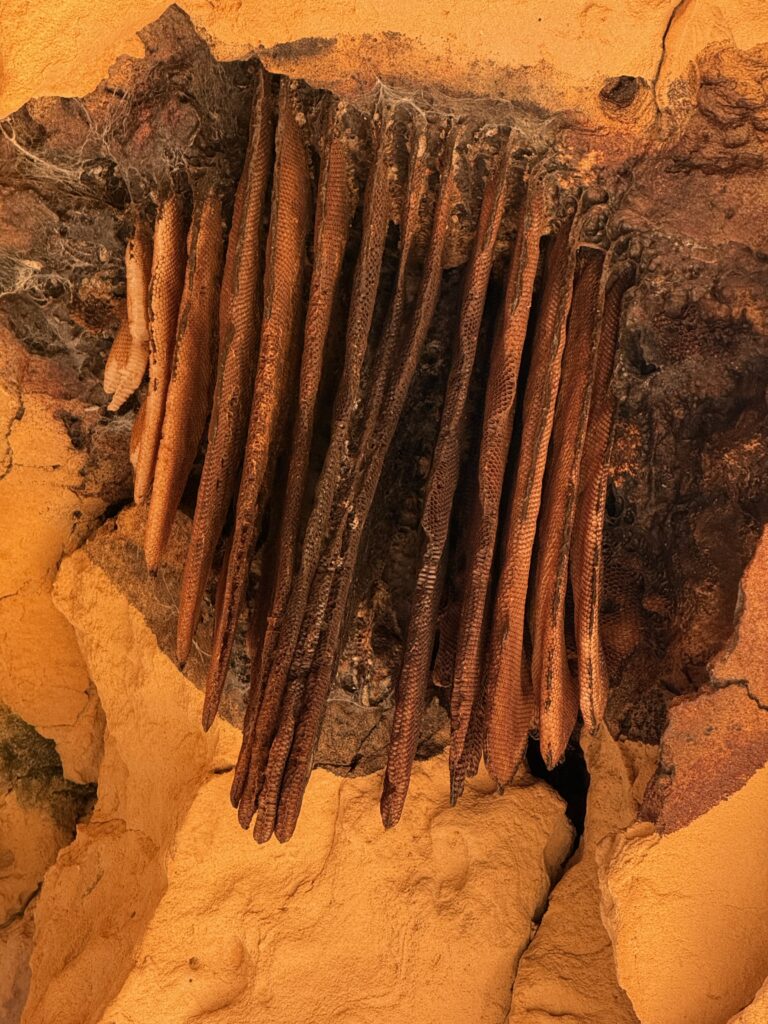
Last weekend I visited wild honeybee nests at De Hoop Nature Reserve as part of my ongoing field work. De Hoop is about 340 km² and is surrounded by farmlands, mostly canola farms, which require honeybee pollination during the winter months.
What I found was deeply disturbing.
Out of 10 nests that I checked on the first day, only 4 were active, and they were weak. The next day I checked 29 wild honeybee nests, and only 5 were active. The pattern was the same as on the first day: twenty-four nests were empty, and the colonies that remained were weak.
This is not normal.
In South Africa we do not see collapse of wild colonies like this. Our wild honeybee colonies may reduce in size when floral resources are lower, but they do not simply disappear in large numbers during periods of good forage and mild weather.
This is currently a productive time for bees at De Hoop, with abundant food and suitable temperatures.
What I witnessed points strongly to disease.
My field assessment is that this is most likely linked to American foulbrood (AFB), probably introduced through managed honeybee colonies brought into the surrounding agricultural landscape for pollination, particularly the nearby canola systems.
This is one of the hidden dangers facing wild honeybees.
Even when bees live inside a protected reserve, they are not necessarily protected from what happens beyond the reserve boundaries.
If a reserve is bordered by large-scale agriculture that depends on managed honeybee pollination, wild bees remain vulnerable to disease spillover and ecological disturbance.
Many of South Africa’s major reserves face this challenge.
Addo Elephant National Park is bordered by citrus agriculture, which depends heavily on honeybee pollination.
Bontebok National Park is surrounded by canola agriculture.
This means that even important conservation landscapes may still expose wild bees to serious risk.
This is one of the reasons why the Wild Bee Reserve is so important.
The reserve does not have large-scale agricultural systems on its borders that require mass pollination by managed honeybees.
That matters enormously.
It means the wild honeybees living there have a far greater chance of remaining protected from disease pressure associated with industrial agricultural systems.
Most of South Africa’s honeybees still live in the wild, and this is such an important thing to maintain, as wild-living bees are much healthier than managed (and often hybridised) honeybees.
Protecting truly safe wild landscapes for them is now urgent.
What I witnessed at De Hoop reinforced something I already knew deeply:
Protected land alone is not enough.
We must also protect the ecological integrity of the landscape surrounding that land.
The Wild Bee Reserve offers something increasingly rare — the possibility of a wild refuge where bees can remain truly wild, living in a landscape with far less human-driven pressure.
After seeing so many empty nests at De Hoop, the urgency of creating the first Wild Bee Reserve feels stronger than ever.
We cannot assume wild bees are safe simply because they still exist.
We need places where they can live beyond the reach of pressures humans continue to impose on them.
Share this link with your friends.

 About The Wonderment Co-op