The Cruelty Footprint of Honey: Why It Doesn’t Belong to Us
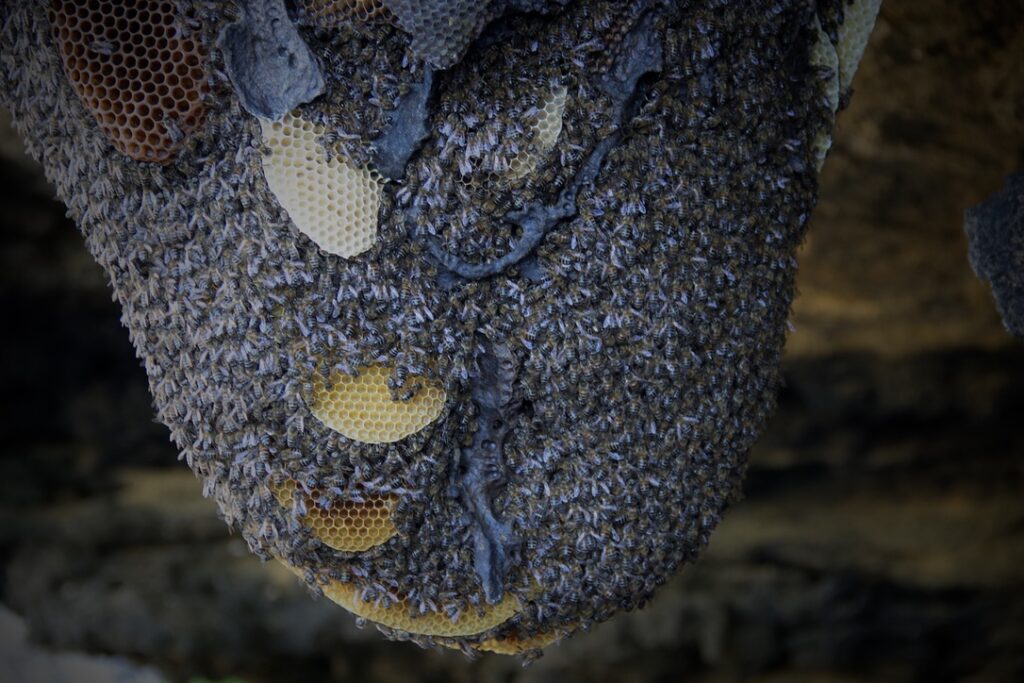
Honey is the bees’ food — not ours.
From the wild bees’ perspective, the harvesting of honey is not a harmless or generous exchange. It is an act of taking. Of intrusion. It comes with a cruelty footprint that is too often unseen — or deliberately hidden.
Wild honeybees make only as much honey as they need. No more. Their lives are guided by balance — not greed. In making just enough, they leave nectar in the flowers for the rest of the world: for butterflies, birds, ants, wasps, beetles, moths. They live in harmony with all the other nectar seekers. They know their place in the wider ecology. They take only what is needed, for their family.
But the moment humans removed bees from the wild, this balance was broken.
We placed them in boxes — filing cabinets for honey. These hives do not mimic the cavities of the wild. They are not homes. They are factories. Built not for the bees, but for human extraction and control. Their purpose is not shelter, but productivity.
To harvest honey from bees is not a simple act. It is not a gift. It is a theft — of food, of labour, of life. The moment we industrialised the honeybee, we forced them to overproduce. We interfered with their evolution — an ancient rhythm refined over millions of years, where every act served the good of the whole. That wisdom has been disrupted. Replaced with exploitation.
This is not ethical. This is not in right relation.
The Harm of Beekeeping: Poison, Displacement, and the Disruption of Wild Intelligence
Modern beekeeping often exposes honeybees to monocultures — vast tracts of single crops drenched in pesticides and herbicides. These industrialised landscapes offer an unnatural abundance of a single, often toxic, food source. Bees are trucked in and out of these crops, forced into pollination contracts with no rest, no stability, and no connection to place. They are not allowed to synchronise with their surroundings — something honeybees do so beautifully in the wild.
This constant displacement severs them from the rhythms of the land. It prevents them from choosing their own homes, building their own nests, and cohabiting with the living architecture of their biome. Even so-called “static apiaries” — where hives remain in one place — deny bees the gifts of wild cavities, natural architecture, and mutualistic relationships. These hives are still filing cabinets. Still factories. Still forms of control.
In every form of beekeeping, the bees’ wellbeing is compromised. Their autonomy is stripped. Their deep intelligence — one refined over millions of years in service to the whole — is interrupted and overridden.
This is not partnership. It is exploitation.
Beekeeping — in its very structure — is extractive. It prioritises honey over harmony. It boosts honeybee populations far beyond the natural carrying capacity of the biome, which disrupts the balance of pollination networks and outcompetes solitary bees and other native pollinators. The harm is not only to the honeybees, but to the entire web of life that depends on pollination.
The destruction is on all levels — in the bees, beyond the bees, and into the soil of the ecosystems themselves.
The Ethics of Honey: A Product of Extraction and Deception
Eating honey is not an ethical act. Behind every spoonful lies an extractive cruelty footprint — one that is invisible in jars, but deeply felt by the bees. If we could see the energetic cost, the displacement, the severing of instinct, and the forced overproduction, most would be horrified.
And honey is only the beginning.
Bees are also stripped of their wax, their pollen, their propolis — sacred materials essential to their immunity, their young, their nest, and their survival. These are not “byproducts.” They are not ours to take. Yet the industry markets them as health supplements and beauty enhancers, exploiting both bees and human longing for wellness.
But here is what the industry does not tell us:
The truth is this: these so-called “bee products” are not about health. They are about profit.
The food industry has no true concern for human wellbeing, and even less for the bees or the ecosystems they nourish. It is a system built on disconnection — from origin, from process, from consequence. Most people have no idea where their food comes from, or what was harmed to create it.
But the bees know.
Honey belongs to the bees. It was never meant for us.
To come into right relation with the natural world, we must stop exploiting bees. We must stop stealing what is not ours. We must begin again — in humility, in reverence, and in restraint.
Honey as Poison: A Hidden Hazard to Bees and Humans
Modern honey is not only stolen — it is toxic.
The vast majority of commercial honey comes from industrial agriculture, where bees forage on pesticide-laden crops. These chemicals — herbicides, fungicides, neonicotinoids — do not disappear in the process. They are concentrated in the honey itself. Every spoonful may contain residues that harm not just the bees, but the humans who consume it.
This is not health food.
It is a cocktail of contamination — a sweet illusion masking the bitter truth.
Pesticide residues in honey are known to damage human cells, disrupt endocrine function, and trigger cancer development. For the bees, these poisons impair memory, navigation, reproduction, and immunity. The nectar that once sustained life has been turned into a slow poison.
To call this “natural” is deception.
To feed it to children is ignorance.
To market it as medicine is betrayal — of both bees and people.
Sugar-Coated Illusions: The Myth of Honey as Health
Beyond the pesticides, honey is sugar. And not just a little — it is around 80% sugar by weight, primarily glucose and fructose. While it may carry trace amounts of antioxidants or enzymes, these are vastly outweighed by the metabolic burden it places on the body.
Sugar is sugar.
And excess sugar is linked to inflammation, insulin resistance, heart disease, obesity, and other chronic conditions. The idea that honey is a “healthy” alternative to sugar is not supported by science — only by marketing.
We must ask: is a substance stolen from a struggling species, loaded with pesticides, and metabolically harmful truly “medicine”?
Or is it simply another story we’ve told ourselves to justify the taking?
A Return to Right Relationship
Wild bees have survived for millions of years not by dominance, but by harmony. Their way is not extractive — it is cooperative. They understand what it means to belong to a place, to live in right relation with all other beings, to take only what is needed and give back through pollination, renewal, and interconnection.
Their intelligence is the intelligence of the ecosystem itself — woven through fire and seed, rhythm and season, form and function.
What the wild bees show us is this:
To live in alignment with nature is to be responsible for our actions.
To work for the good of the whole.
To cause no harm.
To understand our place within the fabric, not above it.
This is not a metaphor. It is a way of being.
In this new era — this time of rethinking, remembering, and returning — we must learn again to cooperate with Nature’s genius.
To tread gently.
To listen.
To stop taking what was never ours.
To respect the bees is to honour the harmony they embody.
To become humble enough to learn from them.

Share this link with your friends.

 More About the Cooperative