Entering a Different Era
Without solitary bees, the terrestrial landscape begins to change
Shifts in Timing: Listening to the Solitary Bees
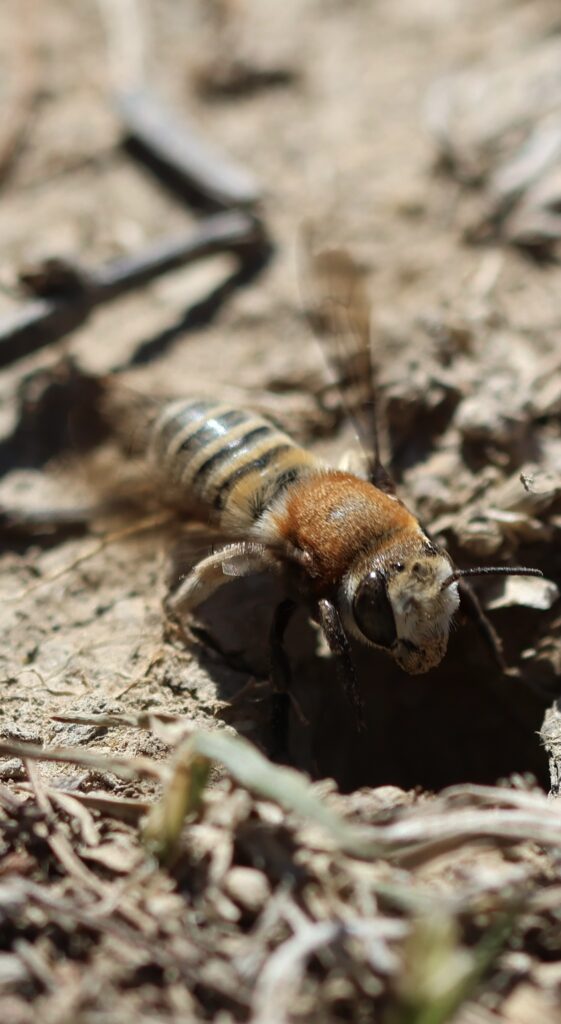
Out in the Karoo I observed a solitary bee nesting outside of her usual time.
This is something I watch for carefully.
The bees often show us what is changing before we understand it ourselves.
In this area two strong forces are at play.
The first is ecological disturbance. Farming has fundamentally altered the system, and with it has come a large influx of honeybees. This happens at the same time that the solitary bee diversity is at its peak.
The second is the broader movement of climate change, which is shifting the natural rhythms in ways we are only beginning to understand.
Within this complexity, I observed a solitary bee making a different timing choice.
This raises an important question.
How do the bees know when to emerge, and what happens when the cues they rely on begin to shift?
Entering a Different Time
With the drought breaking, the first rains brought a strong signal into the system. Rain has always marked the possibility of renewal, a cue that life may begin to move again.
But the response is not immediate.
The flowers take time to emerge, creating a space between signal and expression.
Within this shifting pattern, I observed a solitary bee nesting outside of her usual timing.
But she was not simply early, or out of rhythm.
She had emerged into a different window.
At this time, the managed honeybees are not present on the land. Only the wild-living honeybees remain, forming part of the natural system.
This places her in a quieter ecological space, where competition for flowers is reduced.
Yet this window carries its own conditions.
The temperatures are cooler.
The mornings take longer to warm.
The nights are colder.
Some rain interrupts days available for flight.
And the flowers she relies on are different, still responding to the recent rains.
This is not an easier time.
It is a different one.
After many years of pressure from managed honey bees during peak flowering periods, it is possible that some solitary bees are shifting their timing.
Not in reaction to a single cue, but in response to a changing field of conditions.
The bee I observed is not outside the system.
She is moving within it, occupying a new space in time.
Not All Can Follow
The bee I observed is a ground-nesting leafcutter bee.
Her body is densely covered in hair, and her nest is held within the soil.
These are not small details.
They allow her to retain warmth and to remain buffered from the colder conditions above ground. The soil holds a more stable temperature, offering protection through the night and into the early morning hours.
This makes it possible for her to function within a cooler, less predictable time window.
But not all solitary bees are able to do this.
Many species have less insulation.
Some nest in hollow stems or shallow cavities, exposed to the fluctuations of air temperature.
Others rely on warmer, more stable conditions to become active and to forage effectively.
For these bees, this shifted timing may not be accessible.
What appears as an opening for one may be a closing for another.
This raises a more difficult understanding.
Adaptation does not happen evenly across a community.
Some species are able to move.
Others are held in place by the limits of their own biology.
Within a changing system, this creates a quiet divergence.
Some begin to occupy new spaces in time.
Others may struggle to remain within the old ones.
And over time, this can lead to loss.
Reading the Change
What I observed does not feel like a simple response to rain, or even to climate alone.
It feels like something more complex is being read.
The bee is not responding to one signal in isolation.
She is moving within a field of changing conditions — moisture, temperature, flowering patterns, and the presence or absence of other bees.
These are not separate pieces of information.
They form a living pattern.
The introduction of managed honeybees into this system over many years has altered that pattern in a significant way.
Their presence during peak flowering times has created a sustained pressure on the solitary bees who rely on the same resources.
This pressure does not disappear.
It becomes part of the conditions that must be navigated.
What I observed suggests that some bees are not only responding to immediate environmental cues, but are also moving in relation to these longer-term changes.
The bee I encountered appeared already positioned within this shift.
Not reacting in the moment, but living within a different timing.
There is also something more difficult to name.
Through long observation, I have come to understand that bees do not move only in response to physical cues. There is a coherence in the way they live, a responsiveness to patterns that are not always immediately visible.
It is as if they are reading the wider field of life around them.
What I witnessed felt like part of that.
Not a single decision, but a continuity of knowing carried across generations.
A way of adjusting that is both precise and subtle
What Is At Stake
Solitary bees are not interchangeable.
Many are specialist pollinators, closely linked to particular plants and flowering patterns. Their timing, behaviour and biology are part of a finely tuned system.
In a landscape like the Karoo, this relationship is especially important. It is one of the most diverse semi-desert regions in the world, where life exists through precise and often fragile connections.
If certain solitary bees are unable to adapt to these changing conditions, the impact does not stop with them.
The plants that rely on them may begin to fail in their reproduction.
Over time, this alters the composition of the vegetation itself.
And as the plants change, so too does everything connected to them.
What is at stake is not only the future of individual bee species, but the integrity of the landscape as a whole.
A Changing Relationship
What is becoming visible through these observations is not only a change in the bees.
It is a change in the system we have created around them.
The introduction of managed honeybees, combined with shifting climate patterns, is reshaping the conditions under which solitary bees live.
Some are finding new pathways.
Others may not be able to follow.
This is not a distant or abstract process.
It is happening now, within the lives of individual bees.
To witness this is to be asked something in return.
To look more closely.
To understand the consequences of our actions.
And to consider what it means to live in right relation with the natural world.
To adjust, so that the wider community of life can continue to thrive within a changing world.
Saving what remains of Nature is now more relevant than ever.
Share this link with your friends.

 About The Wonderment Co-op